A damp band that starts at the ground, climbs the wall in an uneven fringe and leaves white salts above it is the classic sign of rising damp. It mostly affects old walls built in soft stone, brick or lime mortar, and very rarely recent buildings. Before painting, rendering or fixing any decor, confirm where the water comes from: if it is the ground, a waterproof render on top will only push the moisture higher up the wall.
How does rising damp form?
Water in the soil is drawn up through the pores of the materials at the base of the wall. It evaporates from the visible faces and leaves behind the mineral salts it carried, which show as whitish efflorescence and sometimes saltpetre. The hotter the weather, the stronger the evaporation and the pull.
Two situations make it worse. One is a wall with no damp-proof course, which is normal in old buildings. The other is sealed ground against the wall (a slab, concrete or outdoor tiles): the water can no longer evaporate through the soil and concentrates in the wall. According to France's building quality agency (AQC), the marks are fringed or wavy and can climb several metres above ground; the lower part is darker and saturated.
Rising damp, penetrating damp or condensation: how to tell?
These are three different sources of moisture and they are not fixed the same way. Work through them in this order:
- The age of the building. Saint-Gobain's French advice site notes that a building put up after 1960 should in principle not show this problem: France's first DTU 20.1 building standard (January 1961) required a damp-proof course 15 cm above the highest finished ground. On a recent house, look elsewhere first.
- The shape of the mark. A continuous low band running along the foot of the whole wall points to the ground. An isolated patch under a window, in a corner or below a gutter points to a leak or a drainage fault.
- Splashback. Rain bouncing off a pavement or terrace also wets the bottom of the facade. It is a separate cause, but AQC also lists it as something that defeats a damp-proof course placed too low.
- Condensation. It comes from indoor water vapour, shows mainly in poorly ventilated rooms with mould, and is fixed by ventilation, not by treating the wall base.
If two causes look possible, the AQC sheet calls for a preliminary diagnosis. Saint-Gobain adds that only a specialist, working from a set of clues, can pin down the cause with certainty.
Why does a waterproof render make it worse?
This is the most common renovation mistake. A cement render or any vapour-tight coating stops evaporation near the ground. The water keeps rising, finds no way out and migrates higher: AQC calls this an aggravating factor. The nastiest case is the "wick effect": the damp-proof course is fine, but the render runs lower than it and carries water up the wall. Saint-Gobain says the same: hiding the damaged part of the wall only makes things worse, and the marks reappear higher up.
What are the fixes, and what do they cost?
The AQC sheet separates curative treatments, which try to stop the rise, from palliative ones, which reduce its effects. The cost figures below come from a single French source (Saint-Gobain, page updated October 2024), so treat them as a rough guide to the order of magnitude, in euros:
| Solution | Principle | Rough cost |
|---|---|---|
| Perimeter drainage | Carry water away from the wall (palliative) | about €120 per linear metre |
| Injected damp-proof barrier | Resin or water-repellent mortar injected at the wall base (curative) | €20 to €200 per linear metre; lasts around ten years |
| Electro-osmosis | Electric unit that reverses the flow of water (curative) | €500 to €2,500 for a 15 m wall, 50 cm thick |
Low-tech palliatives remain useful: clear the ground away from the wall base so it can dry, and replace a sealed floor covering against the facade with gravel. Atmospheric siphons can create thermal bridges, according to Saint-Gobain. Use a certified professional for this kind of work.
What to check before rendering or adding decor
- Is the mark still damp in a dry summer as well as in winter? A band that stays wet in dry weather points to the ground.
- Is a slab or sealed covering glued against the wall? Swapping it for gravel may be enough to improve things.
- Does the bottom edge of the render sit above the damp-proof course, as the AQC sheet requires for new builds?
- Are gutters and downpipes watertight, with the water discharged away from the wall?
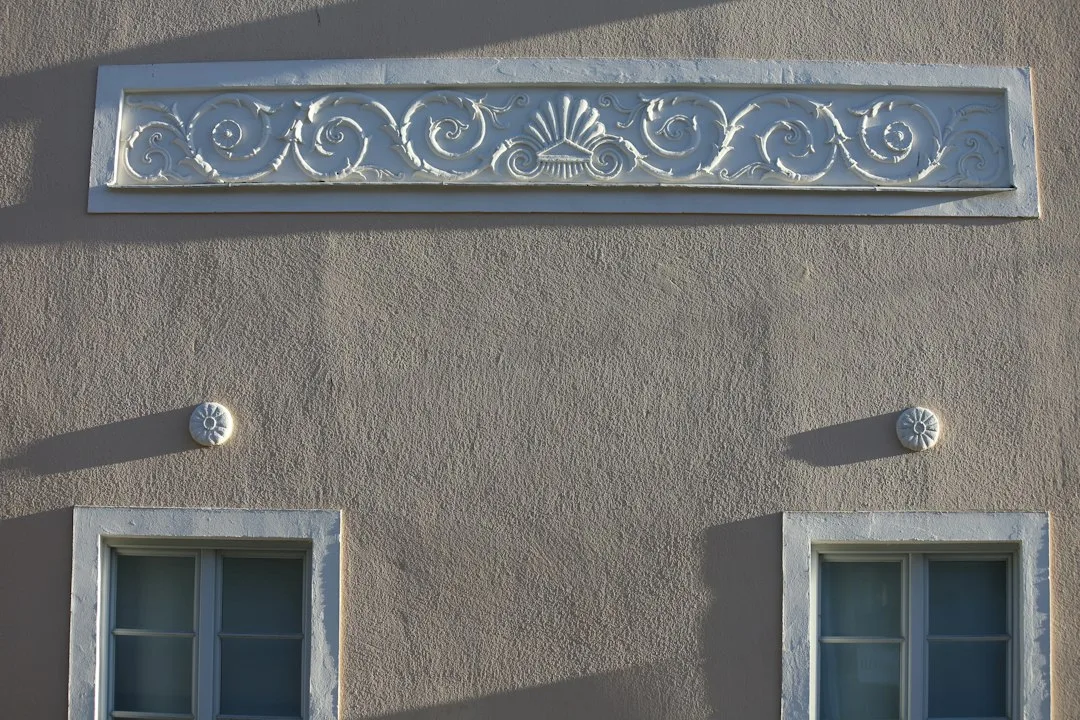
A decorative element stuck onto a wall that stays saturated at the base will sit in that moisture. Treat or at least control the cause before decorating, and fix decor above the low splash zone. For the wall base itself, see our article on EPS facade swelling and capillary absorption.
Sources
- AQC (France): rising damp, building pathology sheet B.01 (in French)
- La Maison Saint-Gobain (France): treating rising damp (in French)