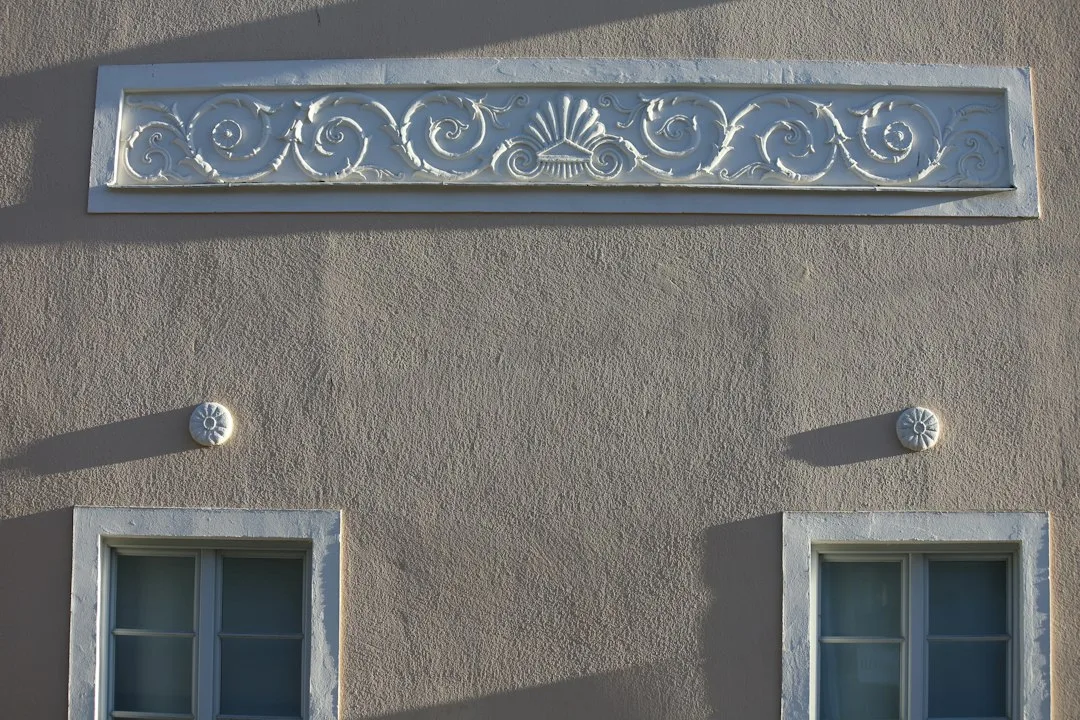
We fuss over mouldings, render color and window surrounds, then drop a catalogue gate at the edge of the street. The facade tells one story and the entrance tells another. Yet the gate, the low wall and the path are what people see first, long before the upper floor.
Matching the entrance to the facade does not take a huge extra budget. It takes deciding in the right order, and checking a planning rule that many owners only discover too late.
Start with the rules, not the gate model
In France, a fence does not normally need planning permission. Several cases change that: a protected area (near a listed monument or in a heritage zone), a local plan (PLU) that makes fences subject to a prior declaration, or a municipal decision applying the same rule to the whole town. In a protected area the heritage architect's opinion is added, and the review takes longer.
The local plan also governs appearance: height, materials, colors, how much of the fence is solid or open, sometimes a required building line along the road. These limits vary from town to town, so there is no single figure to remember for a wire fence or a wooden panel. The safe approach is to read your zone's regulations, or ask the town hall's planning office, before choosing anything. The same logic applies if you are outside France: check your local zoning rules first.
As a guide, a prior declaration is usually reviewed within a month, longer when a heritage opinion is needed. Allow for that before ordering a made-to-measure gate, which itself takes several weeks to make.
Borrow three things from the facade, not ten
The classic mistake is to repeat everything. A gate covered in motifs that copy every molding looks heavy. Borrow three things instead:
- color: the gate should talk to the window frames or trim, without necessarily being identical;
- proportion: if the windows are tall, vertical bars and gate piers taller than they are wide extend the same rhythm;
- one recurring detail: a pier cap, a small cornice, a band echoing the one on the facade.
The rest can stay plain. A restrained but consistent decoration looks designed; a pile-up looks the opposite.
Piers and low walls: where the decoration really happens
The gate itself is usually metal or wood, hard to tie to a rendered facade. Piers and low walls are masonry and can get the same finish as the house: same render texture, same color, same coping or cornice profiles. That is where the visual link is made.
A pier topped with a small cap and a molded band echoes the vocabulary of the facade trim. Decorative expanded polystyrene (EPS) pieces with an acrylic coating are light, which makes them easier to fit to an existing pier, but they still need a sound, dry substrate, a suitable adhesive and properly treated joints, just as on a facade. See exterior molding for profiles that translate easily to a pier.
Watch the water: a coping or wall cap should overhang slightly and slope, so rain does not run down the pier and stain the render.
Height, visibility and security: the trade-offs
A solid gate shields you from view but hides the facade you have just worked on. An open gate shows the house and lightens the whole, at the cost of some privacy. Many owners settle on a compromise: a low solid wall topped with slim bars, with taller piers to punctuate the line.
Think about daily use as well: enough width to maneuver a car, a swing that does not reach onto the pavement, a letterbox and lighting built into the pier rather than added later. Improvised utility items are what most often spoil an entrance.
Test the whole picture before anything is made
Before ordering, run a simulation: a photo montage of the facade with the gate projected onto it, or a full-size cardboard mock-up. Compare three scenarios (gate color, pier height, solid or open) rather than approving one model. Look from the street, at the distance where a passer-by sees the house, not from the doorstep.
In short: rules first, three borrowed elements, piers treated as an extension of the facade, and a visual test before anything is made. That is the shortest route to an entrance that looks as if it has always belonged to the house.